
Run your hand along the top edge of your cabinet doors. That sticky film that isn’t quite dust and isn’t quite oil? That’s aerosolized cooking fat that landed, cooled, and grabbed every particle of dust in the room. It has been building since the day you moved in.
It’s also why four other things in your kitchen misbehave. Your range hood moves less air than it used to. Your air fryer smells like last month’s salmon. Your cabinet paint is peeling near the stove. Your dishwasher smells even though it’s clean.
Here’s the part the product labels won’t tell you: kitchen grease isn’t one substance. Fresh splatter and year-old hood buildup are chemically different problems, and the bottle that solves one is the wrong bottle for the other.
Three kinds of grease, three different fixes
Fresh grease. Today’s splatter, still soft. Any surfactant lifts it. You do not need a specialty product for this, and if you buy one you’ll conclude degreasers are magic when really you just cleaned something easy.
Cured grease. Weeks to months old. Heat and oxygen have cross-linked the oil into something closer to varnish than to fat. Surfactants struggle here. This is what needs a real degreaser and, more importantly, time.
Carbonized grease. The black lacquer on burner grates and oven door glass. Chemistry alone rarely finishes the job. This needs a paste or a scraper doing mechanical work.
Almost every disappointed review of a degreaser is someone applying a category-two product to a category-three mess.
What to use for each job
Everyday surfaces: Krud Kutter Original (~$10 for 32 oz)
Ready to use, no mixing, and EPA Safer Choice certified. That certification matters more than it sounds: it’s what lets you spray it on a counter you prep food on, and use it in a small kitchen without the fumes chasing you out.
Best for counters, the fridge exterior, the tops of cabinet doors, the wall behind the stove. It softens carbonized deposits rather than dissolving them, so don’t expect it to strip a burner grate.
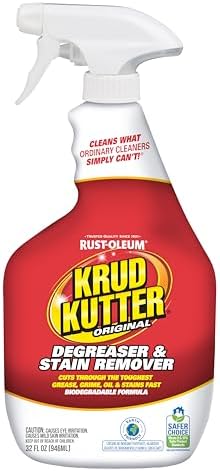
- CUTS GREASE AND GRIME: Water-based cleaner degreaser is designed to cut grease, oil, grime, tar and wax fast
- ORIGINAL STAIN REMOVER: Removes tough soils including soap scum, dried latex paint, tape residue, adhesives, marker, cra…
- CONCENTRATED FORMULA: Use full strength for heavy cleaning or dilute as directed for all-purpose and light cleaning jobs
Neglected jobs: Zep Heavy-Duty Citrus (~$12, concentrate)
Sold as a concentrate you dilute yourself, and it’s what restaurant crews reach for. That tells you both how well it works and how careful you need to be. Citrus degreasers work on d-limonene, which penetrates cured grease faster than a standard cleaner does.
Best for move-out cleans, a rental stove nobody has touched, hood filters gone opaque. Diluted, one bottle lasts long enough that the cost per clean is the lowest of anything here. Wear gloves, ventilate, and keep it off finished wood.

- Great To Use On: Appliances, Grills, Stovetops, Concrete, Tools, Engines, Fiberglass, Aluminum, Stainless Steel And Kitc…
- GREAT TO USE ON: Appliances, grills, stovetops, concrete, tools, engines, fiberglass, aluminum, stainless steel and kitc…
- DO NOT USE ON: Glass, acrylic glass, plastics, auto paint, leather or natural stone surfaces
Anything vertical: Goo Gone Kitchen Degreaser (~$8, foaming)
The foam is the entire point. Liquid sprays run straight down a range hood or backsplash and pool on the stovetop before they’ve done anything useful. Foam stays put and keeps working where you sprayed it.
Best for hood exteriors, backsplash, cabinet fronts, the side of the fridge. Slower than a spray on large flat surfaces, so it isn’t your counter cleaner.

- Cleans Counters – fast-working formula that won’t harm your counters
- One-Step Cleaner – foaming formula great for use on counters, stoves, rang hoods, pots pans and more
- Works On – kitchen grease, grime, and baked-on food
Baked-on stovetop mess: Easy-Off Heavy Duty (~$7)
Fast, cheap, aggressive. Best for drip pans, burner grates and oven door glass. Rinse thoroughly if it touches anything food adjacent, and keep it away from delicate finishes.
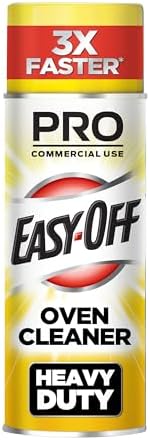
- HEAVY DUTY OVEN CLEANER: Specially formulated to penetrate tough, burned-on grease and food in as little as 3 minutes
- MULTIPURPOSE: Use to clean ovens, oven doors, barbecue grills, broilers, broiler pans and stainless-steel surfaces
- FOR OCCASIONAL DEEP CLEANING: Great for occasional deep cleaning or everyday tough spot cleanings. Use on warm or cold s…
Fresh grease: Dawn Powerwash (~$6)
Not sold as a degreaser, but it’s a sprayable surfactant and it’s genuinely good at oil that hasn’t cured. Best for same-day splatter and greasy pans. It will disappoint you on anything old, and that’s not a flaw in the product, it’s the cross-linking problem above.

- Removes up to 99% of grease and grime in half the time* (*vs. leading competitive brand’s ultra-strength formula on a re…
- 3 cleaning boosters not found in traditional dish soaps
- Power of an overnight soak in minutes
The corners a spray can’t reach: The Pink Stuff paste (~$6)
A mild abrasive paste rather than a chemical, which means it stays exactly where you put it. Best for the seam where the cooktop meets the trim, burner grates, the inside of the oven door. Read the surface warnings below before you reach for it.

- POWERFUL MULTI PURPOSE CLEANER: Tackle grease, grime, stains, and buildup with The Pink Stuff Cleaning Paste. Designed f…
- REMOVES TOUGH STAINS & BUILDUP: Cuts through burnt-on food, soap scum, limescale, and everyday dirt on ovens, sinks, til…
- NON-SCRATCH FORMULA: Effective cleaning paste that works hard on stains while remaining suitable for a wide range of sur…
The rule that matters more than the brand
Dwell time beats scrubbing.
Cured grease has to be softened before it can be lifted, and softening is a chemical process that takes minutes. Spray it, walk away, come back. Five minutes of doing nothing removes more grease than five minutes of scrubbing, and it doesn’t wreck your shoulder.
For genuinely bad buildup, spray at night and wipe in the morning. Most of the “this product did nothing” reviews are people who sprayed and immediately wiped.
Surfaces where you need to stop and think
Air fryer baskets. Never abrasive, never a scouring pad, never a strong alkaline degreaser. The nonstick coating is thin, and a scoured basket sheds coating into your food. Warm soapy water, a soft brush, patience. If the coating is already flaking, the basket is finished and no cleaner brings it back.
Aluminum mesh hood filters. This one catches people out. Strong alkaline degreasers and oven cleaners react with aluminum and can leave it permanently dulled and chalky. Use a mild degreaser and hot water, or run the filter alone through the dishwasher. Test a corner first.
Glass and ceramic cooktops. Non-abrasive only, or you’ll see fine scratches under every kitchen light for the rest of the appliance’s life.
Never mix products. Especially anything with bleach and anything with ammonia. One product, rinse, then the next if you must.
Rinse anything you eat off. Counters, cutting surfaces, the inside of the fridge. Degreaser residue is not food.
If you’re degreasing before painting your cabinets
This is where most cabinet paint jobs fail, and they fail months later rather than on day one.
Doors near a stove carry years of cooking fat. Primer bonds to the fat instead of to the wood. Everything looks perfect for a season, then the paint lifts at the edges where hands touch it. Sanding over grease doesn’t remove it, it spreads it and drives it into the grain.
The order that works: degrease, rinse with clean water, dry completely, then sand, then vacuum and tack cloth, then prime. Degreasing comes before the sandpaper, not after. Use something stronger than your weekly cleaner, and give it a full day to dry before you sand.
Want to test them yourself?
If you’re curious which one wins in your kitchen, here’s a fair way to find out with one afternoon and six sheet pans.
Brush a 50/50 mix of bacon fat and vegetable oil onto each pan, dust lightly with flour to mimic the dust that sticks to real kitchen grease, bake at 400°F for 40 minutes, then let them sit 24 hours to harden. Spray one product per pan, wait the dwell time on its own label, then wipe once with a fresh microfiber cloth using light pressure. Count how many extra wipes each one needs.
The result will depend on your grease, your water and your cloth, which is exactly why I’d rather you ran it than took my word for it.
What I’d actually buy
Two bottles, not six.
One mild everyday spray for the surfaces you touch daily, and one concentrate for the twice-a-year jobs and anything you’re prepping to paint. Six half-empty bottles under the sink is what happens when you buy a product per mess instead of a product per category.
And whichever you buy, spray it and leave it alone for five minutes. That’s the part that does the work.