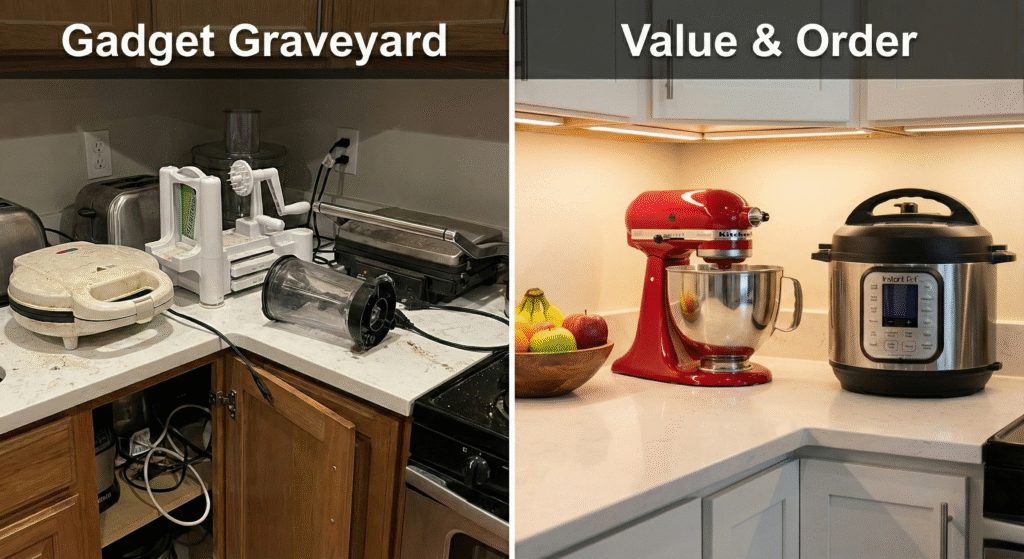
Introduction: Escaping the Gadget Graveyard
Every American kitchen has one: the “Gadget Graveyard” tucked in the back of a cabinet or banished to the basement. That panini press you used twice. The bread maker gathering dust. The spiralizer that promised to revolutionize your vegetables. These impulse purchases represent more than wasted money—they’re monuments to wasted counter space, cluttered cabinets, and the disappointment of unfulfilled kitchen dreams.
The true cost of a poor appliance investment isn’t just the initial price tag. It’s the 18 inches of prime real estate it monopolizes on your countertop. It’s the mental burden of ownership guilt every time you see it. It’s the opportunity cost of what could have occupied that space instead.
This guide introduces the Value Formula—a strategic framework that separates genuine workhorses from expensive dust collectors. By calculating Cost Per Use and weighing space efficiency against functionality, you’ll make purchases that earn their place in your kitchen for decades, not months.
Section II: Cost Per Use (CPU) – The Durability Argument
The most powerful metric for justifying a major appliance purchase is Cost Per Use (CPU). This simple calculation reveals the true economics of durability:
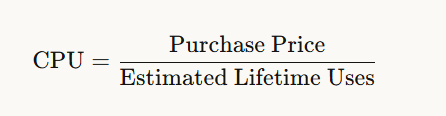
A $450 appliance sounds expensive until you realize it will serve you 2,000 times over 15 years—that’s $0.23 per use. Meanwhile, a $79 gadget used 12 times before retirement costs $6.58 per use.
The Gold Standard: KitchenAid Artisan Stand Mixer
Few appliances demonstrate this principle better than the iconic stand mixer. An initial investment in a KitchenAid Artisan translates to a negligible cost per use when you consider its 15+ year longevity. Weekly bread baking, holiday cookie marathons, pasta making, and everyday mixing tasks add up to thousands of uses. The all-metal gears, repairable motor, and available replacement parts mean this isn’t just an appliance—it’s a multi-generational kitchen asset. At approximately $0.15-0.30 per use over its lifetime, the upfront cost becomes almost irrelevant compared to the cumulative value delivered.
Section III: Case Study: The Clutter Battle (Air Fryers and Multicookers)
The Problem: Specialization vs. Consolidation
The modern kitchen faces a brutal space equation: specialized appliances often perform their single task beautifully, but multi-function devices promise to replace three or four unitaskers. Which path delivers better long-term value?
Analysis 1: Air Fryers – Size Matters
Compact Basket Models excel for individuals or couples with limited counter space. They heat quickly, clean easily, and tuck away in cabinets. Models like the Cosori Pro II 5.8QT deliver excellent crisping performance in a 12×12-inch footprint. The drawback? They’re single-purpose devices that still require a separate toaster oven.
Toaster Oven Air Fryers demand significantly more counter real estate (roughly 18×16 inches), but they eliminate multiple appliances. These hybrids replace your toaster oven, air fryer, conventional toaster, and sometimes dehydrator. If you’re currently housing all these separate devices, the consolidation actually frees space while reducing cabinet clutter. The trade-off: slower preheating and more complex cleaning protocols.
The CPU Verdict: If you already own a reliable toaster oven, the compact basket model wins. If you’re replacing multiple aging appliances or starting fresh, the larger hybrid delivers superior long-term value despite its footprint.
Analysis 2: Multicookers – The Ultimate Space Saver
The Instant Pot revolution succeeded because it actually delivered on its consolidation promise. The Instant Pot Duo Crisp genuinely replaces a pressure cooker, slow cooker, rice cooker, steamer, yogurt maker, sauté pan, and (with the Crisp lid) an air fryer. That’s seven appliances condensed into one 13-inch-diameter unit.
The CPU calculation becomes compelling: even at $150-180, weekly use across its multiple functions yields thousands of lifetime uses. The maintenance burden is reasonable—primarily the silicone ring (which absorbs odors) and periodic deep cleaning. The noise factor during pressure release can be startling, but it’s brief. For households cooking diverse cuisines or needing “set it and forget it” functionality, few appliances deliver comparable value per square inch of counter space occupied.
Section IV: Case Study: Simplicity vs. Sophistication (Coffee Machines)
The Problem: The Hidden Cost of Complexity
Coffee equipment represents the kitchen’s greatest value spectrum—from $30 drip makers to $3,000 espresso machines. But price alone tells only part of the story. The hidden cost lies in daily maintenance, descaling requirements, and the time commitment each brewing method demands.
Analysis: Drip vs. Espresso
Quality Drip Coffee Makers embody simplicity done right. SCA-certified machines like the Technivorm Moccamaster brew at optimal temperatures (195-205°F) and complete the process in 4-6 minutes with minimal user intervention. Handmade in the Netherlands since 1968, the Moccamaster’s copper boiling element maintains precise temperature control throughout the brewing cycle. Maintenance consists of monthly descaling and basic cleaning—perhaps 10 minutes per month. The CPU calculation is favorable: $310-360 initial cost, 10-15 year lifespan (backed by a 5-year warranty), daily use equals roughly $0.06-0.10 per pot.
The trade-off? You’re limited to drip coffee. No espresso, no milk-based specialty drinks.
Home Espresso Machines deliver café-quality beverages but demand commitment. Semi-automatic machines like the Breville Barista Express require grinding, tamping, temperature surfing, and milk steaming knowledge. The footprint is substantial (13×16 inches), and the maintenance burden is significant: daily group head cleaning, weekly backflushing, monthly descaling, and grinder cleaning.
The CPU becomes less favorable unless you’re replacing $5-7 daily café purchases. At $700-900 upfront, even with a 7-year lifespan and twice-daily use, you’re looking at $0.20-0.25 per drink—but only if you factor in the 10-15 minutes per session for preparation and cleanup.
The Verdict: If coffee is a quick morning ritual, the Moccamaster wins decisively with its legendary durability and effortless operation. If espresso-making is a valued hobby and you’re genuinely replacing daily café trips, the semi-automatic machine justifies its complexity. The middle ground—pod machines—delivers convenience but terrible CPU economics with ongoing capsule costs.
Section V: The Final Verdict: Appliances That Truly Earn Their Space
Not every appliance deserves permanent counter residency. The value equation demands three criteria: favorable CPU calculation, genuine multi-year durability, and functionality that justifies its footprint.
Best Value Picks That Pass the Test:
Best Lifetime/Durability Value: The KitchenAid Artisan Stand Mixer
Repairable, multi-generational longevity, and versatile enough for weekly use across baking, cooking, and food prep tasks. The $350-450 investment delivers 15+ years of service at pennies per use.
Best Trend/Efficiency Value: The Instant Pot Duo Crisp
Seven appliances in one 13-inch footprint. Genuinely simplifies meal prep while reducing cabinet clutter. The pressure cooking alone justifies ownership; the air fryer lid makes it exceptional.
The Bottom Line
Before adding any appliance to your kitchen, calculate its true cost: purchase price divided by realistic lifetime uses, multiplied by the space burden it imposes. The best appliances disappear into your routine, used so frequently they become indispensable. The worst become expensive reminders of marketing promises that exceeded reality.
Choose durability over trends. Choose consolidation over specialization. Choose appliances that earn their space every single week—not just the week you bought them.