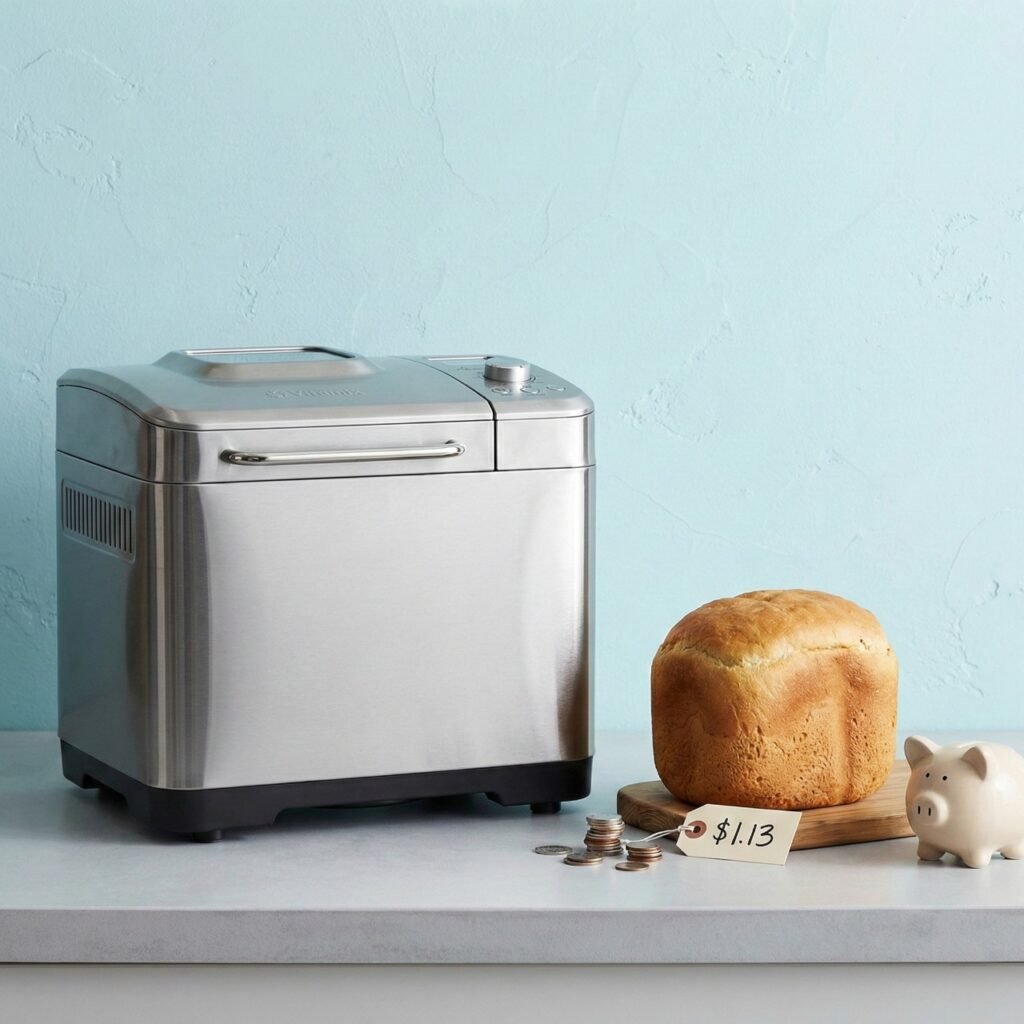
In the current economic climate, the “grocery store shock” has become a weekly ritual for American families. While a gallon of milk or a dozen eggs often grab the headlines, the price of a quality loaf of bread has quietly climbed to staggering heights. In 2026, finding a loaf of organic, preservative-free artisan bread at retailers like Whole Foods or Erewhon for under $7.00 is becoming a challenge.
This brings us to a classic kitchen debate: Is a bread machine a legitimate financial investment or just another piece of “countertop clutter”?
As an investor, I don’t look at kitchen gadgets as mere tools; I look at them as assets. In this expert cost analysis, we’re going to break down the Return on Investment (ROI) of owning a bread machine, the “hidden” costs of electricity, and whether the math actually supports making your own daily bread.
Bread Machine ROI: 5 Hidden Reasons to Bake at Home
Ten years ago, buying a loaf of bread was an afterthought. Today, it’s a line item. If your family consumes two loaves of high-quality multigrain or sourdough bread per week, you are looking at an annual spend of roughly $624 to $728.
When you compare that to the one-time cost of a bread machine—ranging from $60 to $350—the potential for savings is immediate. But to find the true ROI, we have to look past the sticker price and dive into the cost of raw materials.
The Spreadsheet Breakdown: Cost Per Loaf
To get a realistic figure, we analyzed current US market prices for bulk ingredients (buying in 5lb or 10lb bags at stores like Costco or Walmart).
The Ingredient Cost (Standard 1.5lb White/Wheat Loaf):
- All-Purpose/Bread Flour: $0.65 (approx. 3.5 cups)
- Yeast: $0.15 (bought in bulk jars)
- Salt & Sugar: $0.05
- Butter/Oil: $0.20
- Electricity (US Average): $0.08 per cycle
Total Cost to Make: ~$1.13 per loaf
The Savings Gap:
- Store-Bought Artisan Bread: $6.50
- Homemade Bread: $1.13
- Net Savings per Loaf: $5.37
The ROI Formula
To calculate how long it takes for your machine to pay for itself, use this simple equation:
Days to Payback =Cost of Machine Savings per Loaf × Loaves per Day
If you buy a mid-range $120 machine and bake twice a week, you will reach your “break-even point” in just 11 weeks. Everything after that is pure profit.
Top 3 Bread Machine Investments for 2026
When choosing a machine, you must decide between a “Budget Starter” and a “Long-Term Asset.” Here are my top recommendations based on durability and performance.
1. The Gold Standard (Best Long-Term ROI): Zojirushi Home Bakery Virtuoso Plus
If you are serious about replacing store-bought bread forever, this is the “Vitamix” of bread machines. It features dual kneading blades and a dedicated heater in the lid for a perfect crust color.
- Target Audience: Families baking 3+ times a week.
- Pros: Incredible durability; dual blades for traditional rectangular loaves.
2. The Best Mid-Range Value: Cuisinart Compact Automatic Bread Maker
This machine offers a smaller footprint for kitchens with limited counter space. It’s reliable, consistent, and much quieter than budget models.
- Target Audience: Couples or small families.
- Pros: Vertical loaf saves space; 12 pre-programmed options.
3. The Budget Entry Point: Hamilton Beach Bread Maker
For under $100, this is the quickest way to start your ROI journey. While it lacks the refined settings of a Zojirushi, it produces a solid loaf for a fraction of the entry cost.
- Target Audience: Beginners testing the waters.
- Pros: Rapid payback period (less than 2 months).
Beyond the Dollars: The “Health Dividend”
As any savvy investor knows, some of the best returns aren’t found on a balance sheet—they’re found in your health.
Standard store-bought bread in the US is notorious for containing High Fructose Corn Syrup (HFCS), Calcium Propionate (a preservative), and DATEM (an emulsifier). When you bake at home, your ingredient list is four items long: Flour, Water, Salt, Yeast.
By eliminating inflammatory oils and hidden sugars, you are investing in long-term wellness, which reduces future healthcare “maintenance” costs.
Common Pitfalls: Why Some Machines Don’t Pay Off
Not every bread machine purchase results in a positive ROI. Here are the three most common mistakes:
- The “Dust Collector” Syndrome: Buying a machine and only using it once a month. To see a return, the machine must become part of your weekly routine.
- Buying Niche Ingredients: If you only bake with $15-per-bag specialty ancient grains, your cost per loaf will skyrocket, negating the financial benefit.
- The Loaf-Size Mismatch: Buying a 1lb machine for a family of five. You’ll end up buying store bread anyway because the machine can’t keep up with demand.
Frequently Asked Questions (FAQ)
Is it cheaper to bake bread in the oven or a bread machine?
The bread machine is actually more cost-effective. A standard kitchen oven requires significant energy to preheat and maintain a high temperature in a large cavity. A bread machine is a small, insulated “micro-oven” that uses about 70% less electricity per loaf.
Does homemade bread stay fresh as long as store-bought?
No. Because it lacks chemical preservatives, homemade bread will start to stale after 2-3 days. Expert Tip: Slice it immediately after cooling and freeze half. It toasts perfectly from frozen, ensuring zero waste.
How much time does it actually take?
This is the “Convenience Tax.” A bread machine requires about 5 minutes of active work (measuring ingredients). The machine handles the 3-hour kneading, rising, and baking process while you sleep or work.
Final Verdict: Is it Worth It?
If you value high-quality bread and have 5 minutes of prep time twice a week, the bread machine is one of the highest-yielding “kitchen investments” you can make.
For a family of four, transitioning from “Premium Store Bread” to “Homemade Bread” can save over $500 per year. That’s more than enough to pay for a high-end Zojirushi and a year’s worth of premium flour.
Ready to start your bread ROI journey? I recommend starting with the [Insert Affiliate Link: Cuisinart Compact] for the perfect balance of price and performance.